
The TIMEleSS project aims at studying interfaces in the Earth’s mantle combining observations from seismology, mineral physics experiments, microstructures, and wave propagation modeling. It is supported through a bilateral grant, from the ANR in France and the DFG in Germany. The project is led by Sébastien Merkel and Nadège Hilairet at the Université de Lille, Christine Thomas and Carmen Sanchez-Valle from the Westfälische Wilhelms-Universität, Münster, and Sergio Speziale from the Deutsche GeoForschungsZentrum, Potsdam.
Project launch: March 2018
Duration: 36 months, extended until December 2022
Total ANR-DFG funding: 700 000 €The active research period of TIMEleSS is now over, but we are still working on our datasets and publications so stay tuned for more!
Latest news
Mid-mantle discontinuities beneath subduction zones linked to depth-dependent deformation of bridgmanite
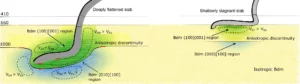 A new publication for TIMEleSS ! This week, former TIMEleSS post-doc John Keith Magali, has a new paper, along with Angelo Pisconti, James Wookey , former TIMEleSS PhD student Jeffrey Gay, and former TIMEleSS PI’s Sébastien Merkel and Christine Thomas. The work was published in Nature Communications on 05 October 2026: Mid-mantle discontinuities beneath subduction zones linked to depth-dependent deformation of bridgmanite.
In this work, we look at bridgmanite, the main mineralogical phase in the Earth’s lower mantle. Bridgmanite is intrinsically anisotropic and may therefore generate seismic anisotropy in actively-deforming regions, particularly subduction zones. The bulk of the lower mantle is widely regarded as well-mixed but recent seismic observations suggest structures at mid-mantle depths whose origin remains unclear. Here, we propose a mechanism that could generate seismic discontinuities beneath subduction zones with depth distributions consistent with some of the observed mid-mantle reflectors.
Eight years after we started, the work is a nice conclusion to the overall TIMEleSS projet. High-pressure experiments we performed identified a gradual transition in plastic deformation mechanisms in bridgmanite with depth. This was the work of PhD student Jeff Gay. Then post-doc John Keith Magali coupled thermo-mechanical subduction models with pressure-dependent plasticity calculations and showed it could manifest as an anisotropic discontinuity near 1000 km. Finally, he used full waveform simulations to show that the predicted discontinuity is indeed detectable with array seismological methods.
These results suggest that mid-mantle reflectors near subduction zones may be strain-induced, providing an additional mechanism that links mantle flow, mineral physics, and seismic observations, which is what we wanted to get to when we started the project!
Doornbos Memorial Prize goes to John Keith Magali
 The Doornbos Memorial Prize is presented to a young scientist by the Committee on Studies of the Earth’s Deep Interior (SEDI) of the International Union of Geodesy and Geophysics (IUGG), in association with their biennial meetings, for outstanding work on the Earth’s deep interior. It is given in honor of the Dutch seismologist, Durk Doornbos.
And this year’s awardee is … former TIMEleSS post-doc John Keith Magali ! John was awarded the prize for his multidisciplinary and original approach combining dynamics and mineral physics to understand and predict seismic structures, in particular near subduction zones.
This prize arises specifically from the work John Keith Magali started during his PhD in Lyon and his following post-doc with TIMEleSS on how to integrate high-pressure experiment results with geodynamical models and compare the model predictions with seismic observations. This is a nice conclusion to the project, 8 years after it started !
Congratulations John !
On the Influence of Pressure, Phase Transitions, and Water on Large-Scale Seismic Anisotropy Underneath a Subduction Zone
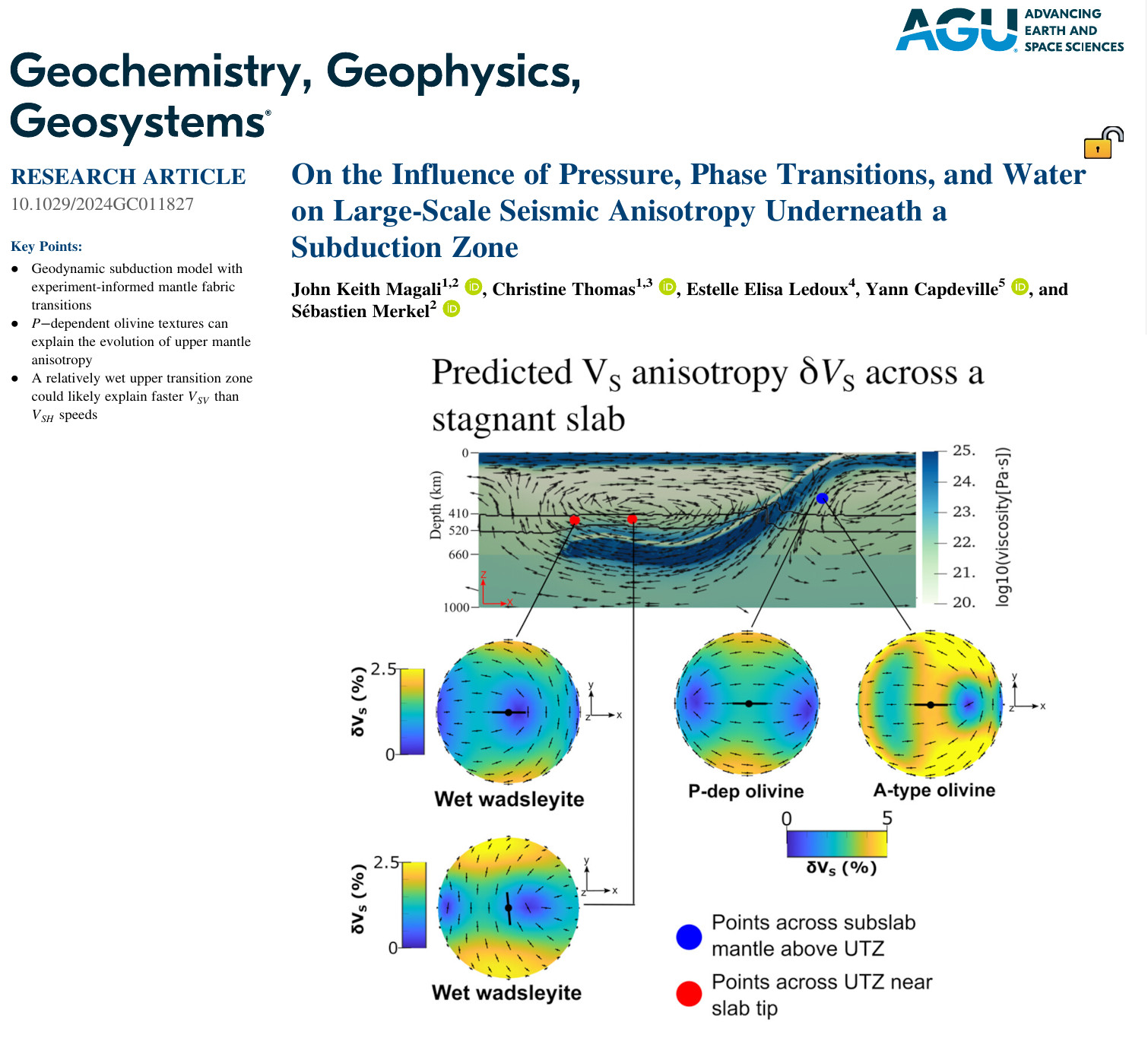 We have a new publication ! In his work published in AGU’s Geochemistry, Geophysics, Geosystems, J.K. Magali investigates the Influence of Pressure, Phase Transitions, and Water on Large-Scale Seismic Anisotropy Underneath a Subduction Zone.
In fact, subduction deep inside the Earth’s mantle causes the surrounding mantle to deform according to the movement and pressure exerted by the plates. This influences the alignment of minerals making up the mantle, which in turn, affects the speed and direction of seismic waves known as seismic anisotropy.
In this publication, we investigate the role of pressure in the upper mantle and water in the transition zone on large‐scale seismic anisotropy across a subduction zone. In the upper mantle, we show that the patterns of anisotropy at places where deformation is presumed to be large are affected by changes in pressure. In the transition zone, anisotropy tends to favor a wetter environment.
Want to know more ? The full reference is here : Magali, J. K., Thomas, C., Ledoux, E. E., Capdeville, Y., & Merkel, S. (2025). On the influence of pressure, phase transitions, and water on large-scale seismic anisotropy underneath a subduction zone. Geochemistry, Geophysics, Geosystems, 26, e2024GC011827. https://doi.org/10.1029/2024GC011827.
Federica Defended her thesis!
 On June 6, 2024, Federic Rochira defended her thesis! She presented her work for 30 minutes, followed by 60 minutes of oral examination, in front of an international committee composed of Tine Thomas as first examiner, Sebastian Rost (University of Leeds) as second examiner, and Alexander Kappes (University of Münster) as third examiner.
In her work, Federica investigated the presence of seismic structures in the Earth’s mantle and their effect on seismic wave paths, using a combination of seismic signals that are thought to travel along the predicted great circle path, between the source and the receiver, as well as signals traveling off the great circle path direction. To better constrain depth and location of mantle reflectors, she took into account directivity parameters of seismic signals, not yet widely used, as well as their traveltime.
Results show the advantages and necessity of using directivity information of seismic signals to detect regional-scale structures in the mantle associated with both subducted slabs and upwelling plumes, as well as mantle discontinuities. Ignoring the directional information, estimated location and depth of reflectors might be inaccurate and contribute to a misleading interpretation of mantle structures in terms of Earth’s dynamics and mineralogy.
She is now a Doctor of the University of Münster. Congratulations!
Partners
Partner institutions
 |
 |
 |
 |
Participating laboratories
 |
 |
 |
 |
Funding bodies
 |
 |
 |