









 A new publication for TIMEleSS ! This week, former TIMEleSS post-doc John Keith Magali, has a new paper, along with Angelo Pisconti, James Wookey , former TIMEleSS PhD student Jeffrey Gay, and former TIMEleSS PI’s Sébastien Merkel and Christine Thomas. The work was published in Nature Communications on 05 October 2026: Mid-mantle discontinuities beneath subduction zones linked to depth-dependent deformation of bridgmanite.
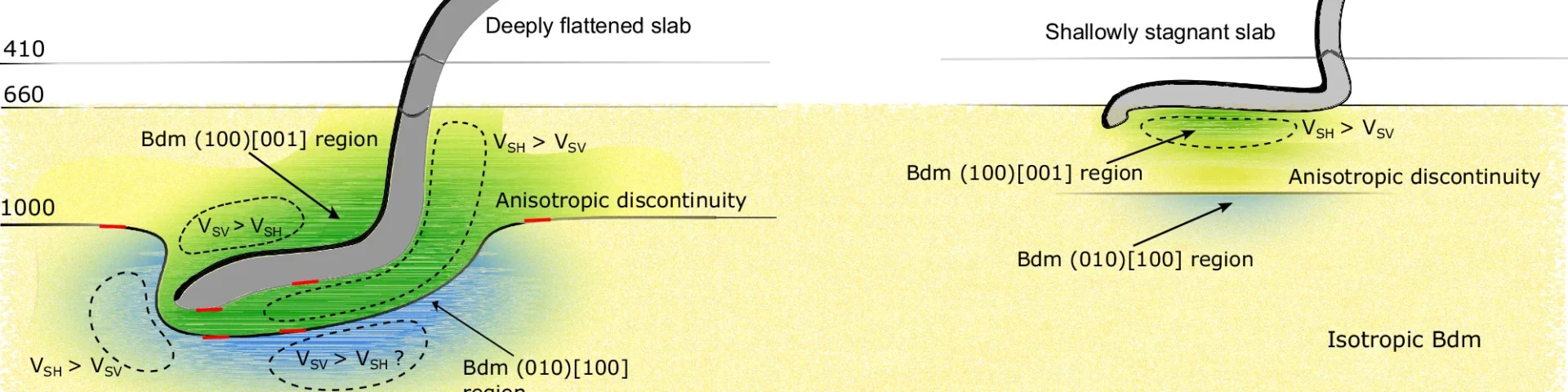
In this work, we look at bridgmanite, the main mineralogical phase in the Earth’s lower mantle. Bridgmanite is intrinsically anisotropic and may therefore generate seismic anisotropy in actively-deforming regions, particularly subduction zones. The bulk of the lower mantle is widely regarded as well-mixed but recent seismic observations suggest structures at mid-mantle depths whose origin remains unclear. Here, we propose a mechanism that could generate seismic discontinuities beneath subduction zones with depth distributions consistent with some of the observed mid-mantle reflectors.
Eight years after we started, the work is a nice conclusion to the overall TIMEleSS projet. High-pressure experiments we performed identified a gradual transition in plastic deformation mechanisms in bridgmanite with depth. This was the work of PhD student Jeff Gay. Then post-doc John Keith Magali coupled thermo-mechanical subduction models with pressure-dependent plasticity calculations and showed it could manifest as an anisotropic discontinuity near 1000 km. Finally, he used full waveform simulations to show that the predicted discontinuity is indeed detectable with array seismological methods.
These results suggest that mid-mantle reflectors near subduction zones may be strain-induced, providing an additional mechanism that links mantle flow, mineral physics, and seismic observations, which is what we wanted to get to when we started the project!